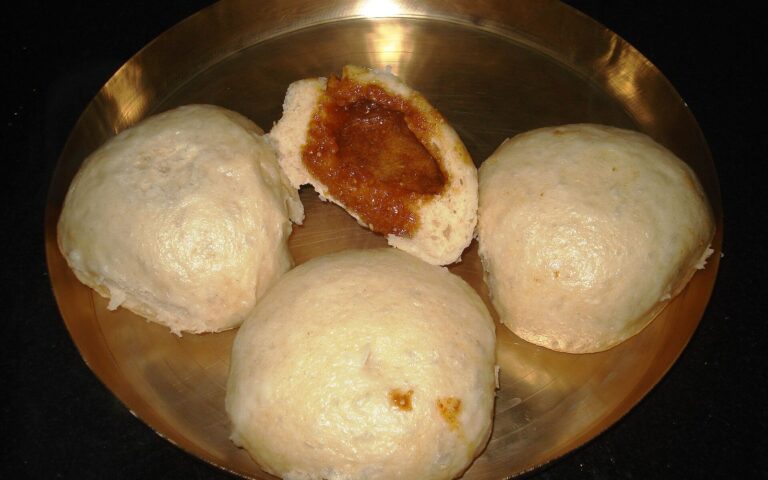
If you have travelled in the hills of Himachal Pradesh, someone has probably handed you a plate with a pale, soft, steaming bun on it, cut open and soaked in ghee. That is a Siddu — and for many pahadi families it is the taste of home.
This guide covers everything you need to know: what Siddu is, how it is made, what goes inside, how to eat it, and where it comes from.
Siddu in one sentence
Siddu is a bread made from whole wheat dough that is fermented with yeast, filled (usually with walnuts and poppy seeds, or a spiced lentil paste), shaped by hand, and steamed until soft and fluffy. It is served hot with desi ghee and chutney.
How Siddu is made
- A soft dough of whole wheat flour, water and yeast is kneaded and left to rise for a few hours, until roughly doubled. Some cooks add a little rice flour for extra softness.
- Meanwhile the filling is prepared — for example walnuts and soaked poppy seeds ground coarse with onion, chilli and coriander, or soaked urad dal ground with ginger and spices.
- The dough is divided, flattened, filled and folded into a half-moon, oval or round, depending on the region.
- The Siddus rest for a few minutes, then go into a steamer for around 15–25 minutes until glossy and springy.
- They are cut open, flooded with melted ghee and served at once.
The rise matters more than anything. As Shimla historian Dr. Anurita Saxena puts it, if the dough does not rise well, the Siddus do not taste good. A good Siddu is light and slightly tangy from fermentation; a bad one is heavy and dense.
What goes inside
The classic filling in the Shimla hills is walnut and poppy seed. In Mandi and Kullu, lentil (dal) fillings are common, and in Mandi you may find minced meat. There are sweet Siddus with jaggery, plain Siddus eaten with dal, and today plenty of modern fillings — paneer, potato, chicken, even cheese. We go deeper in our guide to Siddu fillings across Himachal.
How Siddu is eaten
Always hot. The usual way is to cut a few slits on top and pour over a generous spoon of desi ghee, then eat it with green chutney (mint and coriander) or a red chilli-garlic chutney. Plain Siddus are often eaten with dal, and sweet ones with ghee and jaggery. A cup of strong chai on the side is never a mistake.
Where Siddu comes from
Most accounts trace Siddu to old Mahasu — the former Shimla district — from where it probably spread to Kullu, Mandi and Sirmaur, and later across the whole state. It began as everyday food in farming households and became a dish for guests, gifts and celebrations. Read the full story in our history of Siddu.
Is Siddu the same as momos?
No — though they are often compared because both are stuffed and steamed. Momos use thin, unleavened dough and are small dumplings; Siddu uses thick, yeasted whole wheat dough and is a filling bread, closer to a stuffed bun. We compare them properly in Siddu vs momos vs bhatooru vs tingmo.
Where to try it
Siddu is made at home all over Himachal and sold in dhabas, cafés and roadside stalls in Kullu, Manali, Shimla, Mandi and around Bir. In Bir, you can find ours at the NaamHaiSiddu cart in Khopu, every day from 11am to 11pm — or make your own with our step-by-step Siddu recipes.
Tip: if a Siddu has gone cold, re-steam it for 5 minutes. Never microwave it dry — it turns chewy.
Frequently asked questions
What is Siddu made of?
Siddu is made from fermented whole wheat dough, usually stuffed with walnut and poppy seed or spiced lentil paste, then steamed.
Is Siddu vegetarian?
Traditional Siddu is vegetarian. Some modern and Mandi-style versions use minced meat or chicken.
Is Siddu fried?
No. Siddu is steamed, not fried, which is part of why it feels light despite being filling.
Which state is Siddu from?
Siddu comes from Himachal Pradesh, India — most accounts trace it to the old Mahasu (Shimla) area.